
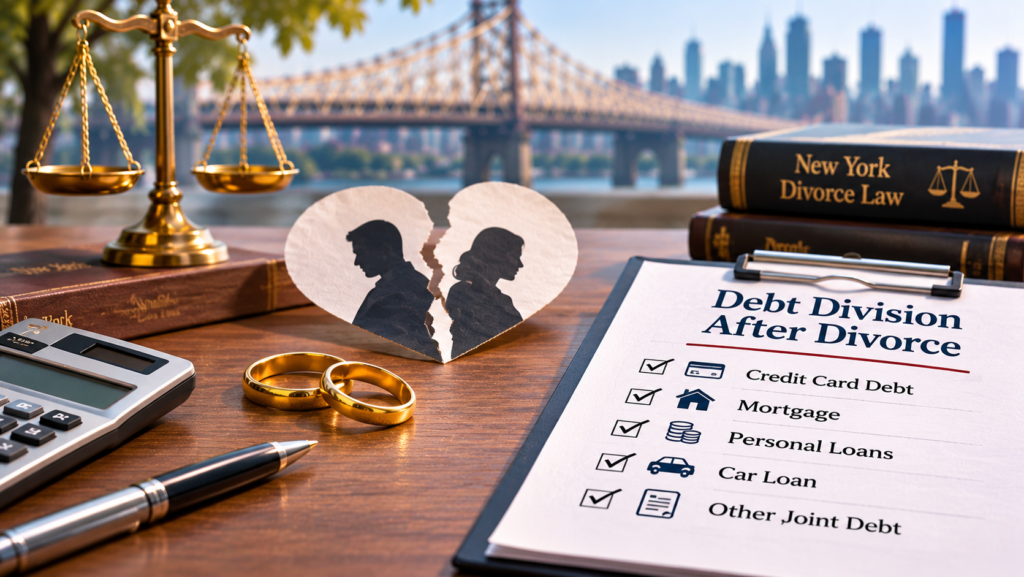
When couples think about divorce, they usually worry about dividing their home, savings, and other assets. But there is another financial question that can be just as important.
What happens to the debt?
Perhaps you and your spouse have a joint credit card. Maybe there is still a mortgage on the family home. Or you recently discovered that your spouse has accumulated thousands of dollars in personal loans.
If you are getting divorced in New York, you may be wondering whether you will have to pay debts you did not personally create.
The answer depends on when the debt was incurred, what the money was used for, whose name is on the account, and the circumstances of your marriage.
At AH Law Firm, PLLC, we help individuals and families in Queens understand their rights and financial responsibilities during divorce.
Is Debt Divided Equally in a New York Divorce?
Not necessarily. New York follows equitable distribution, meaning marital debts are generally allocated fairly based on the circumstances of the marriage.
That does not always mean each spouse will be responsible for exactly half.
For example, if a couple accumulated $20,000 in credit card debt while paying household expenses, the court may treat that amount as marital debt.
However, if one spouse incurred substantial debt for personal purposes unrelated to the marriage, the court may reach a different conclusion.
The key question is whether the debt qualifies as a marital obligation and how responsibility should be allocated.
This is similar to the way courts divide marital assets. You can explore the broader rules in our related article, How Is Property Divided in a Queens Divorce? Equitable vs. Equal Distribution.
What Is Considered Marital Debt in New York?
Marital debt generally includes financial obligations incurred during the marriage for the benefit of the marital partnership.
Common examples include:
- Credit card balances used for groceries, household expenses, or family purchases
- Mortgages on marital property
- Car loans used for family transportation
- Personal loans used to pay shared expenses
- Certain medical expenses
- Loans used for home improvements
However, the fact that a debt was incurred during the marriage does not automatically determine how it will be divided.
Courts may consider why the debt was created, whether the family benefited, and the evidence available to support each spouse’s position.
What About Debt From Before the Marriage?
Debt incurred before marriage is generally treated as the responsibility of the spouse who brought it into the relationship.
For example, if one spouse had a personal credit card balance before getting married, that debt would not ordinarily become marital debt simply because the couple later married.
However, refinancing, consolidating, or otherwise changing financial obligations during the marriage can complicate the analysis.
Who Pays Credit Card Debt After Divorce?
Credit card debt is one of the most common financial disagreements during divorce.
Imagine a couple living in Queens with three credit cards:
- One joint card used for household purchases
- One card in the husband’s name used for family expenses
- One card in the wife’s name used for personal purchases
The court may examine each account separately.
A credit card being in only one spouse’s name does not necessarily mean the debt is solely that spouse’s responsibility in the divorce.
Similarly, a joint account does not automatically mean the divorce court will divide the balance equally.
The purpose of the spending, the timing, and other financial circumstances may matter.
There is also an important distinction between a divorce judgment and a creditor’s rights.
Even if a divorce settlement says your former spouse must pay a joint credit card, the credit card company may still seek payment from you if you remain legally liable under the account agreement.
That is why it is important to address joint debts carefully before finalizing a divorce.
What Happens to a Joint Mortgage After Divorce?
For many Queens families, the mortgage is their largest shared financial obligation.
If both spouses signed the mortgage, both may remain responsible to the lender even after the divorce.
A divorce agreement does not automatically remove either spouse from the loan.
Depending on the circumstances, possible arrangements may include:
Selling the property: The spouses sell the home, pay off the mortgage, and divide any remaining proceeds according to their agreement or court order.
One spouse keeping the home: One spouse may retain ownership and seek to refinance the mortgage in their own name, subject to lender approval.
Temporary arrangements: In some cases, the parties may agree to maintain the property for a period while addressing custody, housing, or financial concerns.
It is important to distinguish between ownership of the home and responsibility for the mortgage.
Transferring ownership does not, by itself, release a borrower from a mortgage obligation.
A divorce lawyer can help you consider these issues before agreeing to a property settlement.
Are You Responsible for Your Spouse’s Personal Loans?
Not always.
Suppose your spouse borrowed $15,000 during the marriage without discussing it with you.
Whether you may be assigned responsibility in the divorce depends partly on how the money was used.
If the loan paid for household repairs or shared family expenses, it may be considered marital debt.
If the money was spent entirely on personal activities unrelated to the marriage, there may be grounds to argue that your spouse should bear responsibility.
However, the outcome depends on the evidence and the specific circumstances.
Bank statements, loan documents, and transaction records may help establish the purpose of the borrowing.
What If Your Spouse Runs Up Debt Before Filing for Divorce?
This is a concern for some couples whose marriages are already breaking down.
One spouse may continue using credit cards, take out loans, or make unusually large purchases while the other is preparing to file.
New York courts may distinguish between debts incurred before and after a divorce action begins. Expenses incurred after commencement are generally treated as the responsibility of the spouse who incurred them, although exceptions and court orders can affect the outcome.
Courts may also consider whether financial transactions were intended to waste marital assets or unfairly affect the other spouse.
If you suspect unusual spending or hidden debt, preserve relevant financial records and seek legal advice before taking action involving shared accounts.
Can You Protect Your Credit During Divorce?
Divorce does not automatically separate your credit history from your spouse’s financial obligations.
If you have joint accounts, missed payments may affect your credit even when a divorce agreement assigns payment responsibility to the other spouse.
There are several practical steps worth considering:
- Review your credit reports. Identify joint accounts, loans, and outstanding balances.
- Gather financial records. Keep copies of credit card statements, mortgage documents, and loan agreements.
- Understand your account obligations. Determine whether you are a joint borrower, co-signer, or authorized user.
- Discuss joint accounts with your attorney. Closing or changing accounts may require careful planning and should not violate court orders.
- Address debts in your divorce settlement. Specify who will pay each obligation and how potential nonpayment will be handled.
These steps may help you better understand your financial position before and after divorce.
What Happens If Your Spouse Refuses to Pay Their Share?
Even after a divorce settlement is signed, disputes can arise.
For example, your former spouse may have agreed to make payments on a joint loan but later stop paying.
Depending on the terms of the divorce judgment, you may have legal remedies to enforce the agreement or court order.
However, enforcement against your former spouse is different from your obligations to a lender.
If your name remains on the account, the creditor’s contractual rights may continue regardless of what your divorce agreement says.
If your spouse is refusing to cooperate with the divorce itself, our article on what happens when a spouse refuses to sign divorce papers in New York explains how the legal process may continue.
How Does Debt Affect the Overall Divorce Settlement?
Debt division is often connected to the division of marital property.
For example, one spouse might receive a larger share of certain assets while also taking responsibility for a greater portion of the marital debt.
In another case, the spouses may agree to pay off joint credit cards using proceeds from selling their home.
These arrangements require careful consideration of the couple’s finances, available assets, and future ability to make payments.
When spouses cannot agree, the court may need to determine an equitable allocation.
Financial disputes can also affect how long the divorce takes. Our guide on divorce timelines in Queens, NY explains some of the factors that can delay proceedings.
Frequently Asked Questions About Debt and Divorce in New York
Am I responsible for my husband’s or wife’s credit card debt after divorce?
Possibly. The court may allocate marital credit card debt between spouses based on the circumstances. Your responsibility to the credit card company also depends on whether you are legally liable for the account.
Is debt always split 50/50 in a New York divorce?
No. Marital debt is subject to equitable distribution, which does not necessarily require an equal division.
Can my spouse make me pay a loan I did not sign?
A divorce court may allocate responsibility for qualifying marital debt even if only one spouse signed the loan. However, whether the lender can collect directly from you is a separate legal question.
Does divorce remove my name from a joint mortgage?
No. A divorce judgment alone does not remove your name from a mortgage. Refinancing, repayment, or a lender-approved release may be necessary.
Who pays credit card debt accumulated after separation?
It depends on the circumstances, including when the divorce action began, the purpose of the spending, and any applicable court orders. Living separately does not automatically determine how every debt will be classified.
Can debt disputes delay an uncontested divorce?
Yes. An uncontested divorce generally requires the spouses to resolve their financial disagreements, including how marital debts will be handled.
Speak With a Divorce Lawyer in Queens About Marital Debt
Divorce is not only about dividing what you own. It is also about understanding what you may still owe.
Credit cards, mortgages, personal loans, and other financial obligations can continue to affect your life long after the marriage ends.
Before agreeing to a divorce settlement, it is important to understand which debts may be marital, which obligations you remain legally responsible for, and how the proposed agreement could affect your finances.
At AH Law Firm, PLLC, we assist individuals and families in Queens with divorce, property division, and other family law matters.
If you are concerned about marital debt or financial obligations during divorce, our team can help you understand your options.
AH Law Firm, PLLC
164-13 Hillside Avenue, Jamaica, NY 11432
Phone: (347) 720-3394
Website: ahlawfirmpllc.com
Family Law Services: Divorce and Family Law in Queens
Contact: Schedule a Consultation
Disclaimer: This article provides general information about New York divorce law and is not legal advice. The classification and allocation of debts depend on individual circumstances, applicable law, and court orders.